Plinko
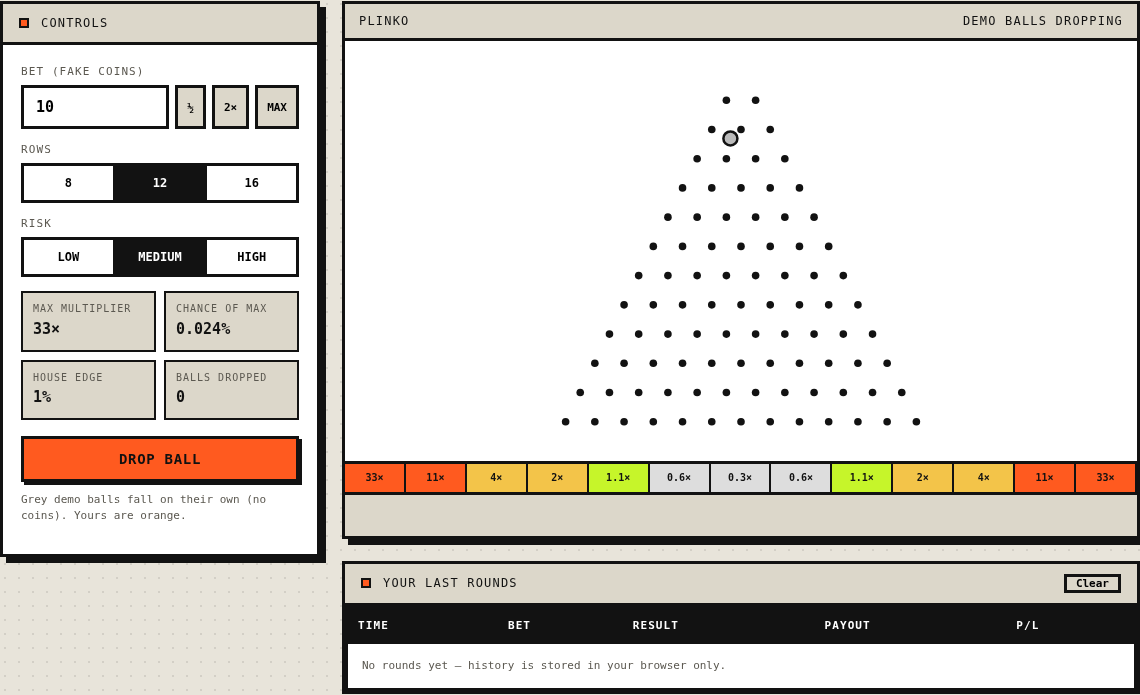
Drop a ball, bounce through pegs, pray for the edge. House edge 1%. Rounds run on their own; place a bet to join the next one. Balance is stored in your browser only.

Grey demo balls fall on their own (no coins). Yours are orange.
| Time | Bet | Result | Payout | P/L |
|---|---|---|---|---|
| No rounds yet — history is stored in your browser only. | ||||
Plinko: a binomial distribution you can watch
A ball drops through 8, 12 or 16 rows of pegs, bouncing left or right at each one with a 50/50 chance. Where it lands follows the binomial distribution: the centre slots are overwhelmingly likely, the edges almost never. With 16 rows, the 1000× edge slot hits once in 65,536 drops. The multiplier tables are built so the weighted average comes to 0.99 — a 1% edge on every risk level.
Risk changes swing, not cost
Low risk keeps most slots near 1×, so your balance drifts slowly. High risk fills the middle with 0.2× slots and the edges with huge numbers — you lose most drops and wait for a rare hit. Both cost exactly 1 coin per 100 wagered over the long run. Hover any slot below the board to see its landing probability.
What are the odds of the 1000× on 16 rows?
1 in 65,536 per drop (0.0015%). Both edge slots together: 1 in 32,768.
Which risk level is best?
None — every table pays 99% back on average. Choose by how much variance you can stomach, not by 'value'.
What are the grey balls?
Demo drops that keep the board alive; they cost nothing and aren't logged. Your balls are orange and go into the history table.
Is the ball path random or physics?
Random: each row is a coin flip decided when you press Drop. The bounce animation is cosmetic.
Plinko — four things worth knowing
- Risk changes swing, not cost. Every table returns 99%.
- On 16 rows, the 1000× slot hits 1 in 65,536 drops. Do not size a session around seeing it.
- Low risk keeps most slots near 1× — good for learning the binomial shape without burning balance.
- Multi-ball drops on real sites multiply turnover, not odds. Ten balls at ◎1 cost exactly what one at ◎10 does.
On the real sites
CSGORoll and Stake both run Plinko with 8/12/16 rows and three risk levels. Multiplier tables differ slightly by site; the 1% edge does not. Codes: CSGORoll GETBOX, CSGOEmpire case2go, CSGO500 CSMAX, CSGOBig headshot, Gamdom 15BOOST, Stake GETRAKEBACK, CSGOFast GETCASE.
How Plinko compares
| Game | House edge | Per ◎1,000 wagered | Variance |
|---|---|---|---|
| Dice | 1% | ◎10 | You choose |
| Crash | 1% | ◎10 | You choose (target) |
| Plinko | 1% | ◎10 | Low → extreme |
| Roll | 6.67% | ◎67 | Medium (green: high) |
| Upgrader | ~10% | ◎100 | Depends on multiplier |
| Case opening | 8–15% | ◎80–150 | High |
| Pick'Em (tool) | 0% | ◎0 | No stake at all |
Edge = expected loss per coin wagered. Variance describes the ride, not the destination.
Other games
Glossary
- House edge
- The share of every wager the operator keeps over the long run. 1% edge = ◎10 expected loss per ◎1,000 wagered.
- RTP
- Return to player — the mirror of house edge. 90% RTP on a case means a 10% edge.
- Expected value (EV)
- What a bet is worth on average: sum of (payout × probability). Always below the stake on a real site.
- Variance
- How much results swing around the average. High variance = long dead runs, rare big hits.
- Provably fair
- A seed-hash system letting you verify a result was fixed before your bet. Proves honesty, not good odds.
- Rakeback
- A percentage of the house edge you generate, returned regardless of win or loss.