CS2 Trade Up Contract Simulator
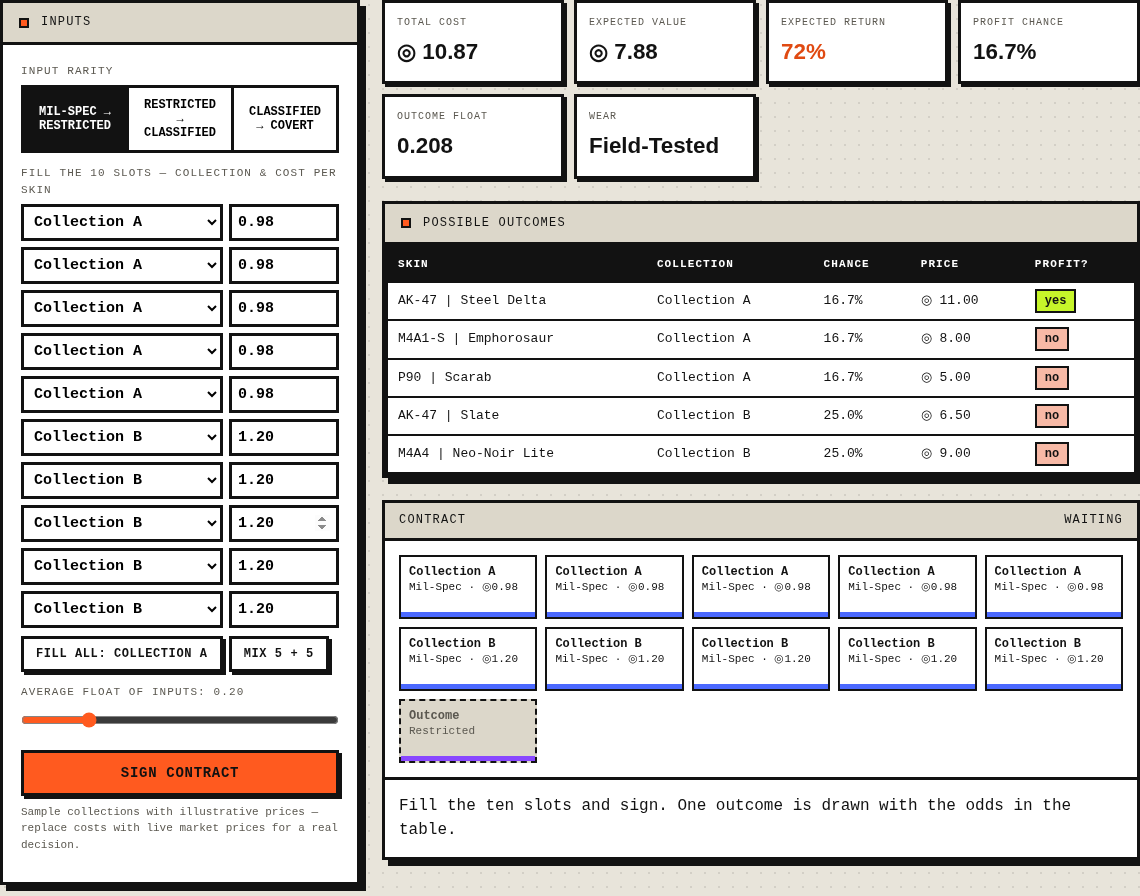
Ten skins in, one skin out — outcome odds, float and EV before you sign. Updates live as you type.
Sample collections with illustrative prices — replace costs with live market prices for a real decision.
| Skin | Collection | Chance | Price | Profit? |
|---|
How a CS2 trade up contract works
Ten skins of one rarity go in, one skin of the next rarity comes out. The outcome is drawn from the next-tier skins of the collections you used: each collection's share of the ten inputs is its share of the odds, split evenly across that collection's next-tier skins. Five Collection A skins and five Collection B skins means a 50% chance of an A outcome and 50% of a B outcome — regardless of which skins inside those collections you used.
Float carries over
The output float is the average input float mapped onto the outcome's own float range. Ten Factory New inputs with an average of 0.03 produce a Factory New outcome if the target skin's range starts low enough. That is why FN inputs are worth more in a trade-up than their wear alone suggests.
Expected value
Multiply every outcome's price by its chance and add them up; compare with the total cost of the inputs. Most "obvious" trade-ups are negative — if the profitable outcome were likely, its price would already have moved. The simulator shows expected return and profit chance before you sign; the Sign contract button draws one outcome using the same odds with your fake coins.
Sample collections here are modelled on real ones with illustrative prices. Replace the costs with live market prices (and the outcome prices in the table with what they actually sell for) to evaluate a real contract.
Can I trade up to a knife?
No. Knives and gloves are not part of any collection's Covert → next-tier chain; Covert is the highest rarity a trade-up can produce.
Does the wear of inputs matter?
Yes. Output float = average input float scaled into the outcome's float range, so Factory New inputs push the outcome towards Factory New.
Do StatTrak inputs give a StatTrak outcome?
On Valve's real contract all ten inputs must share the StatTrak status; the outcome matches it. This simulator ignores StatTrak.
Is a trade-up ever positive EV?
Occasionally, briefly, when market prices drift. Every profitable contract gets arbitraged quickly; check prices the moment you plan to buy inputs.
Is this the real Steam contract?
No. It is a free simulator with fake coins that reproduces the odds and float rules. Nothing touches your inventory.

Worked example: 5 + 5 mixed contract
Five Collection A Mil-Spec inputs at ◎1.00 and five Collection B at ◎1.20 cost ◎11.00. Collection A has three Restricted outcomes (◎11, ◎8, ◎5) and B has two (◎6.50, ◎9). Odds: each A outcome 50%÷3 = 16.7%, each B outcome 25%. EV = 0.167×(11+8+5) + 0.25×(6.5+9) = ◎4.00 + ◎3.88 = ◎7.88 — a 72% expected return. The contract loses money on average even though two outcomes are profitable.
Common mistakes
- Using listed prices instead of what outcomes actually sell for after fees.
- Ignoring float — a Battle-Scarred outcome of a skin that only looks good in Factory New is worth a fraction of the listed price.
- Mixing collections without checking that every outcome from the second collection is worth more than the inputs.
Other calculators
Try the maths live
Every number here can be tested with fake coins: case opening, Roll, Upgrader, Crash.
- House edge
- The share of every wager the operator keeps over the long run. 1% edge = ◎10 expected loss per ◎1,000 wagered.
- RTP
- Return to player — the mirror of house edge. 90% RTP on a case means a 10% edge.
- Expected value (EV)
- What a bet is worth on average: sum of (payout × probability). Always below the stake on a real site.
- Variance
- How much results swing around the average. High variance = long dead runs, rare big hits.
- Provably fair
- A seed-hash system letting you verify a result was fixed before your bet. Proves honesty, not good odds.