The cheapest way to gamble CS2 skins (by the numbers)
Pick a game before you pick a bet. That single decision moves the cost of an evening by a factor of ten, and you make it before a single skin leaves your inventory.
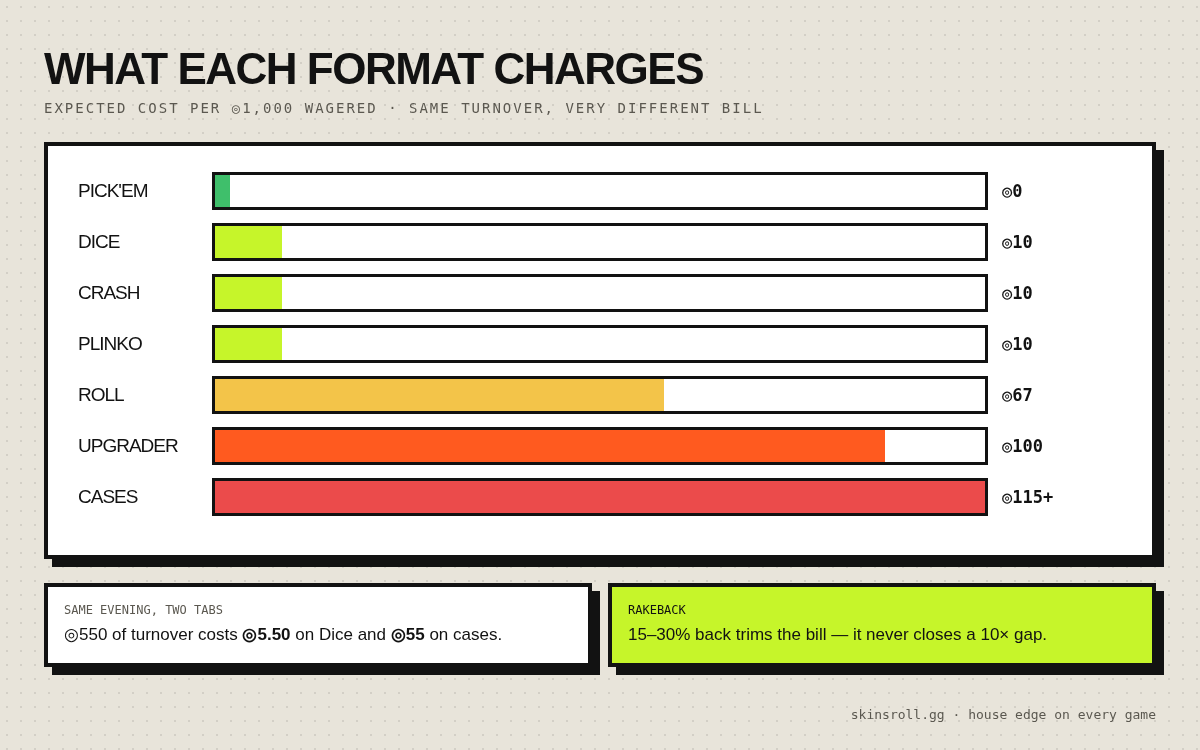
Dice, Crash and Plinko charge about ◎10 per ◎1,000 wagered. Roll charges ◎67. Cases and upgraders charge ◎80–150. Rakeback knocks 10–30% off whichever you pick, but it never closes a gap that large. Game selection beats every betting pattern ever invented.
Every format, ranked by what it charges
House edge is the share of everything you wager that the operator keeps over time. Here is every format on this site, with the cost of pushing ◎1,000 of turnover through it:
| Format | House edge | Cost per ◎1,000 | Where the cost hides |
|---|---|---|---|
| Major Pick'Em | 0% | ◎0 | Nowhere — there is no stake |
| Dice | 1.00% | ◎10 | Printed on screen: chance × multiplier = 99 |
| Crash | 1.00% | ◎10 | The 1% of rounds that crash instantly at 1.00× |
| Plinko | 1.00% | ◎10 | Baked into every multiplier table |
| Roll / Double | 6.67% | ◎67 | The single green slot |
| Upgrader | ~10% | ◎100 | The chance shown is already shaded |
| Case opening | 8–15% | ◎80–150 | The price of the case vs its contents |
| Jackpot pots | ~5–10% | ◎50–100 | The rake taken off the pot |
| Slots (crypto casinos) | 3–6% | ◎30–60 | Volatility disguises the rate |
Read the second and third columns together. The same ◎1,000 of turnover costs ◎10 on Dice and up to ◎150 on a bad case. Nothing you do inside a game — no stake sizing, no pattern, no "system" — moves the number that much.
Why the gap is so wide
Low-edge games compete on maths and know you can check them. Dice puts your exact win chance and payout on screen before you commit, so the only lever the site has is that 1%. High-edge games compete on feel: a case opening is a five-second ceremony with a strip, a sound and a rarity colour, and nobody computes an expected value while it is spinning. You are paying for production values.
That is not a moral judgement. It is just worth knowing which one you are buying.
The Roll trap
Roll — the red/black/green wheel that CSGORoll, CSGOEmpire, CSGOBig, CSGOFast and Gamdom all run in some form — looks like a coin flip and is priced like a slot machine.
Fifteen slots: seven red, seven black, one green. Red pays 2× and lands 7/15 of the time, which is 46.67%, not 50%. Every colour returns 93.33 coins per 100 wagered. Green's 14× payout on a 1-in-15 chance works out to exactly the same expected return as red — it just delivers it in rarer, larger lumps.
Two specific mistakes cost people real money here:
- "Green is due." It is not. Thirty spins without green happens 12.6% of the time; fifty spins happens 3.2% of the time. Both are normal, and neither changes the next spin from 1-in-15. The Roll odds calculator prints these directly.
- Martingale on red. Doubling after every loss works beautifully until the run that does not end. Ten losses in a row on red happens roughly once in every 530 spins and costs 1,023 base bets to chase. The strategy converts many small wins into one catastrophic loss and leaves the −6.67% exactly where it was.
Covering red and black together is the purest version of the trap: you lose 6.67% with certainty every time green lands and gain nothing the rest of the time.
Why cases feel cheaper than they are
A case does not present itself as a bet. There is no stake field and no odds display in your face — there is a price and a shiny strip. But opening a ◎27 case is wagering ◎27, and at a 10% edge that open costs ◎2.70 in expectation before anything lands.
Open twenty of them in an evening and you have wagered ◎550 and paid ◎55 for the privilege. The same ◎550 through Dice costs ◎5.50. Both evenings feel like "a bit of gambling"; one costs ten times the other.
Case battles do not change this. A four-player battle is four opens of the same case — the expected value per case is identical, the battle only decides who ends up holding the items. Our case EV calculator will tell you what any specific case is charging.
Where rakeback actually changes the answer
Rakeback returns a slice of the house edge you generate, on every wager, win or lose, and usually without wagering requirements attached. It is a discount, not income — but it is a real discount, and it stacks on top of whichever game you chose.
| Scenario | Wagered | Edge | Rakeback | Net cost | Effective edge |
|---|---|---|---|---|---|
| Dice + Gamdom 15BOOST | ◎5,000 | 1% | 15% | ◎42.50 | 0.85% |
| Dice + 500.casino CSMAX | ◎5,000 | 1% | 30% | ◎35.00 | 0.70% |
| Roll + 10% rakeback | ◎5,000 | 6.67% | 10% | ◎300.00 | 6.00% |
Look at the bottom row. A generous-sounding rebate on a high-edge game still leaves you paying seven times what the low-edge player pays. The game matters more than the rate. Put your own numbers into the rakeback calculator before you decide which code is worth having.
Turning a percentage into an hourly rate
Percentages are easy to shrug off. Coins per hour is not. Take your usual bet, multiply by how many rounds you actually play in an hour, multiply by the edge:
- ◎5 bets · 200 rounds/hour · 1% edge (Dice) = ◎10 per hour
- ◎5 bets · 200 rounds/hour · 6.67% edge (Roll) = ◎67 per hour
- ◎27 cases · 40 opens/hour · 10% edge = ◎108 per hour
Three evenings a week at the bottom rate is a serious hobby budget. At the top rate it is a different kind of number entirely, and it arrived through a tab you clicked without thinking.
A cheaper way to play the same games
- Play the format free first. Every game on this site runs the real formulas with fake coins — start here — so the expensive lesson costs nothing.
- Choose the low-edge game you actually enjoy. If Dice bores you, Crash is the same 1% with a clock attached.
- Take a rakeback code if you play regularly, a free-case code if you play occasionally. The promo code table lists what each one is worth.
- Open the free cases, then stop. GETBOX gives three, GETCASE gives one plus 10% on deposits. They are the only cases with positive expected value you will ever open.
- Set the number before you start, and treat reaching it as the end of the session rather than a prompt to reconsider.
None of this makes gambling profitable — the edge is non-negotiable and every table above is a cost, not an opportunity. It makes the same entertainment cost a fraction of what it otherwise would, which is the only edge available to a player.
Questions people actually ask
What is the cheapest CS2 gambling game?
Dice, Crash and Plinko at a 1% house edge — about ◎10 per ◎1,000 wagered. Roll costs roughly seven times that and case opening about ten times.
Does rakeback make gambling profitable?
No. Even 100% rakeback would only make a game break-even, and nobody offers that. The best rakeback deals cut a 1% edge to around 0.7%.
Is betting red and black at the same time safe?
It is the opposite of safe in expectation. You lose your whole stake whenever green lands and break even otherwise, which is a guaranteed 6.67% cost per round.
Do case battles have better odds than solo opens?
No. A battle is several people opening the same case; the expected value per case is unchanged. It only redistributes who finishes holding the items.
How much does an evening of case opening really cost?
Twenty ◎27 cases is ◎550 of turnover. At a 10% edge that is ◎55 in expectation — ten times what the same turnover costs on Dice.
Keep reading
Provably fair proves nobody edited your result. It says nothing about whether the case was worth opening — and that is…
Read the post →Blog · 10 minCS2 Major Pick'Em strategy: what 10,000 simulated Majors showThe 3-0 pick is the one everyone gets wrong. Simulating the Swiss stage ten thousand times says take the second favour…
Read the post →18+. SkinsRoll is an independent free-play simulator. Brands mentioned are advertising partners and outbound links are affiliate links — see our affiliate disclosure. Nothing here is betting advice; if gambling stops being fun, get support.