CS2 Pick'Em Calculator
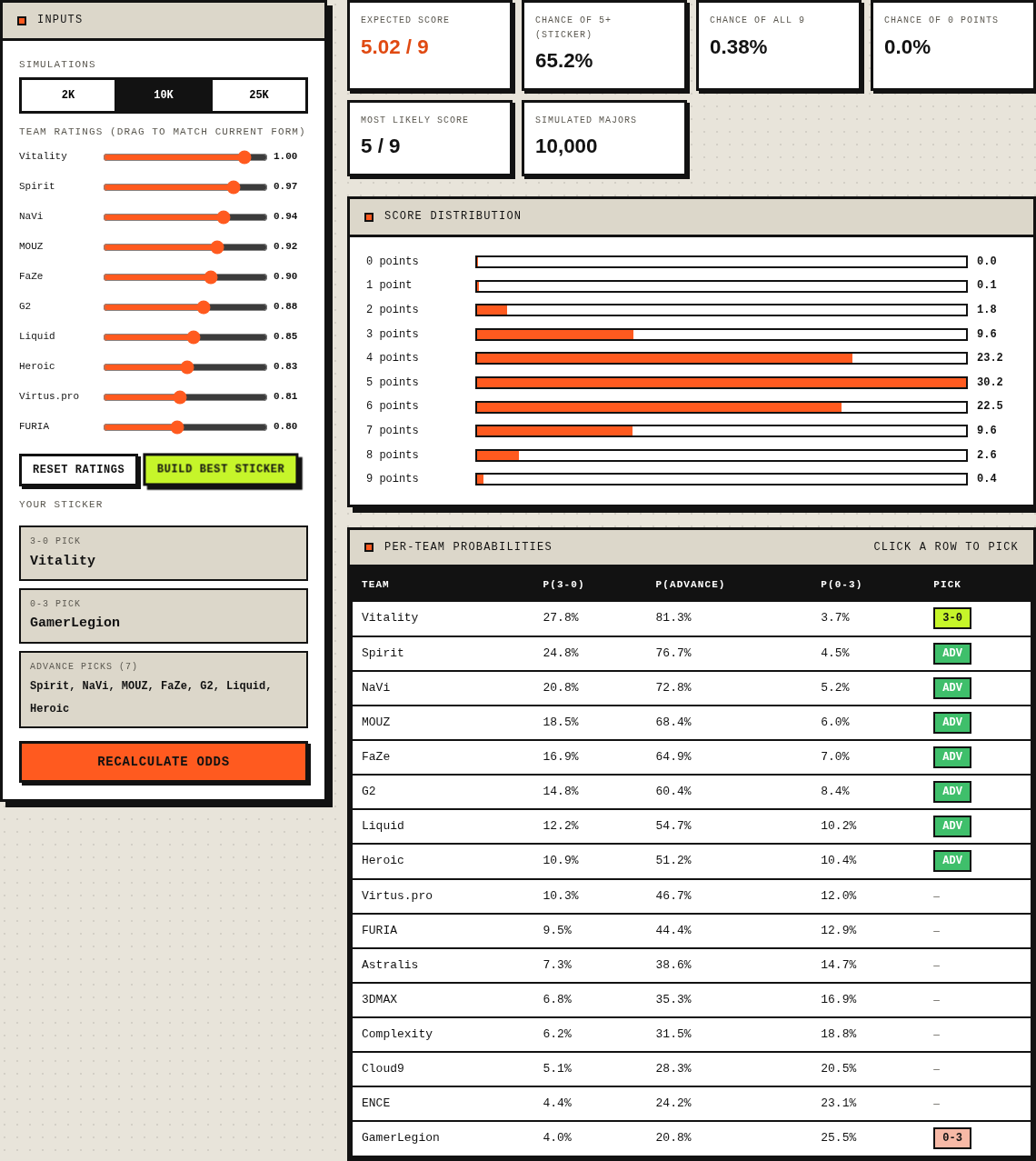
Your sticker's real odds: P(3-0), P(advance), P(0-3) and the chance of hitting five points. Updates live as you type.
| Team | P(3-0) | P(advance) | P(0-3) | Pick |
|---|
What this calculator answers
The Major Pick'Em asks for nine predictions: one team to go 3-0, one to go 0-3, and seven to advance with three wins. Five correct picks earns the sticker. The hard part is that none of those nine events is independent — every result re-seeds the next round, so you cannot multiply a few gut-feel percentages and get an answer.
This calculator does it the only honest way: it plays the whole Swiss stage, with the real Bo1/Bo3 rules, thousands of times. Every run produces a full 16-team record table; the calculator counts how often each team finishes 3-0, advances, or goes 0-3, and how many points your sticker would have scored. Everything runs in your browser — nothing is sent anywhere.
How to use it
- Set the ratings. Each slider is a strength number. The gap between two ratings sets the win probability: 0.10 of rating is roughly a 56/44 match, 0.30 is about a 67/33 one. Real Major fields are tighter than people assume, which is exactly why 3-0 runs are rare. Drag them to match current form.
- Pick your sticker. Click any row in the probability table — first click adds an advance pick, and the 3-0 / 0-3 slots are set from the same table. Or press Build best sticker to take the most likely outcome in every slot.
- Read the distribution. The bar chart is the honest answer: not "will I get five", but how often five happens across thousands of tournaments.
What it tells you that intuition doesn't
Three things surprise most people. The favourite goes 3-0 far less often than its reputation suggests — three straight wins against opponents who are also winning is a hard ask, and the number usually lands in the low twenties of a percent. The 0-3 pick is nearly as hard, because the weakest team still gets matched against other losers in rounds two and three. And the advance picks are where the sticker is actually won: seven picks that each land around two-thirds of the time will, on average, deliver four or five points on their own.
Run it, then open the Pick'Em simulator to watch one of those tournaments play out match by match.
How accurate is this?
It is exactly as accurate as the ratings you give it. The Swiss format, seeding by record and the Bo3 rule for elimination and advancement matches are modelled correctly; the per-match probability comes from the rating gap. Put in current-form numbers and the output is a reasonable prior, not a prediction.
Why not just multiply the percentages?
Because the picks are dependent. If your 3-0 team wins its first two matches, it has beaten two other strong teams, which changes who your advance picks face in round three. Only a full simulation captures that.
What score should I expect?
With a sensible sticker, between four and five out of nine. Five is the sticker threshold, which is why it feels frustrating — the format is tuned so that the typical informed pick lands just short of it.
Is the 3-0 pick worth a point?
It is worth exactly the same one point as an advance pick, while being roughly three times less likely to land. If you are optimising for the sticker rather than for bragging rights, the second favourite is often the better 3-0 slot — it is nearly as likely to run the table and far more likely to be under-picked.

Worked example: the favourite's 3-0
Give the top seed a 1.00 rating and the field the default spread, and the simulator puts its 3-0 chance at roughly one in four — it has to win three matches in a row against opponents who are themselves winning, and the third of those is a Bo3. Meanwhile that same team advances (any 3-x record) about four times in five. One point for a 25% event or one point for an 80% event: the advance slot is where the sticker is actually built, and the 3-0 slot is where it is usually thrown away.
Common mistakes
- Treating the nine picks as independent events — they are not, and multiplying gut-feel percentages always overstates your chances.
- Spending the 3-0 slot on the same team as everyone else instead of the one the odds table actually favours.
- Leaving the ratings at their defaults. The model is only as good as the form you feed it.
Other calculators
Try the maths live
Every number here can be tested with fake coins: case opening, Roll, Upgrader, Crash.
- House edge
- The share of every wager the operator keeps over the long run. 1% edge = ◎10 expected loss per ◎1,000 wagered.
- RTP
- Return to player — the mirror of house edge. 90% RTP on a case means a 10% edge.
- Expected value (EV)
- What a bet is worth on average: sum of (payout × probability). Always below the stake on a real site.
- Variance
- How much results swing around the average. High variance = long dead runs, rare big hits.
- Provably fair
- A seed-hash system letting you verify a result was fixed before your bet. Proves honesty, not good odds.
The maths behind this, written out
The 3-0 pick is the one everyone gets wrong. Simulating the Swiss stage ten thousand times says take the second favour…
Read the post →Blog · 11 minThe cheapest way to gamble CS2 skins (by the numbers)Same ◎1,000 of turnover costs ◎10 on Dice and ◎100 on cases. A ranked breakdown of every format, what it really charge…
Read the post →Blog · 9 minAre CS2 case opening sites rigged?Provably fair proves nobody edited your result. It says nothing about whether the case was worth opening — and that is…
Read the post →New to this? Start with what CS2 skin gambling is, then the house edge guide. Ready to play for real? The promo code table lists every verified code and the reviews score each site out of ten.